

Image by EaglesExplored.com (Third Year Eagle Image by Robin Gwen Agarwal CC BY NC 2.0)
New Survival data for Bald and Golden Eagles
A Look at the Data by Eagles Explored
Science Made Simple – New Survival Data for Bald and Golden Eagles
It’s never easy to think about the risks young eagles face, but the latest science offers a surprisingly hopeful story. Thanks to large-scale studies published in 2021 and 2022 (see references, below), we now have the most accurate survival estimates ever for Bald and Golden Eagles in the wild. These new numbers show that both species are doing better than many people feared, especially during their vulnerable first year. For decades, anecdotal estimates suggested that only 40%–50% of Bald Eagles survived their first year, but recent modeling by Zimmerman et al. (2021) puts that number at 69% for Bald Eagles, and tracking data from Millsap et al. (2022) shows 70% survival for first year Golden Eagles. That’s a profound improvement. It means that, on average, 69 Bald Eagle fledges out of each 100 fledges are surviving their first year, an increase of 20-30 birds (of each 100) over previously held values. This a testament to decades of conservation work, habitat protection, public awareness and dedicated studies. Understanding these survival rates helps us make smarter decisions about eagle management and gives us reason to celebrate how far these iconic birds have come.
By the Numbers – Comparative Survival Rates of Bald and Golden Eagles
| Species | Year 1 | Year 2 | Year 3 | After Year 3 |
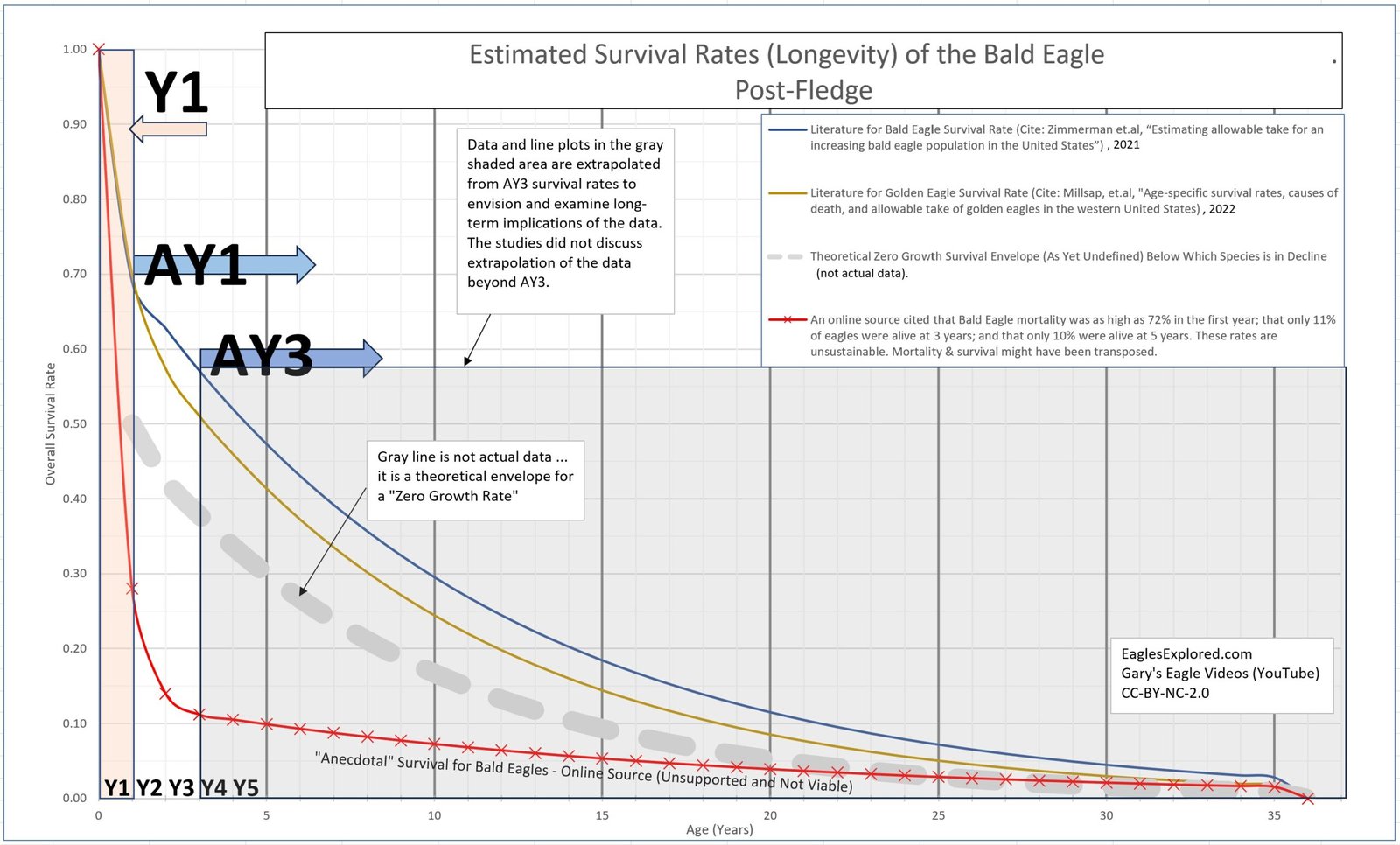
| Bald Eagle | 69% | 91% | 91% | 91% |
| Golden Eagle | 70% | ~82% | ~88% | 90% |
Notes: Year 1 values are for fledges. For Bald Eagles, Zimmerman et al. modeled a constant annual survival rate of 0.91 after the first year, so Years 2, 3 and After Year 3 (AY3) reflect that same value. The values for Year 2 and Year 3 Gold Eagle survival are approximate. They were interpreted from a graph. The specific numbers were not detailed in the paper.
Exploring Eagle Longevity: A Citizen Science “What If”
The graph on this page plots survival rate curves for Bald Eagles and Golden Eagles based on the most recent published data (Zimmerman et al. (2021) for Bald Eagles and Millsap et al. (2022) for Golden Eagles). To explore long-term implications, we’ve taken the liberty of extrapolating the After Year 3 (AY3) survival rates forward in time, continuing each curve until the total survival probability drops below 5%. It’s important to emphasize that neither study claims or implies that these AY3 rates remain valid across decades. This graph is a simple citizen science “what if,” designed to test how well the models align with real-world eagle lifespans. Remarkably, both extrapolated curves fall below 5% survival between 25 and 30 years of age, which matches the upper end of measured and anecdotal lifespan estimates for wild Bald Eagles. While not definitive, this alignment offers a hopeful glimpse into how far these birds can go when given the chance. Click graph to enlarge.
Deep Dive – Methodology Summary
Zimmerman et al. (2021) estimated Bald Eagle survival using the Prescribed Take Level (PTL) framework, a population modeling approach that integrates demographic parameters such as fecundity, age-specific survival, and population growth trends. Zimmerman and colleagues estimated first-year survival rates of bald eagles using a combination of demographic modeling and band recovery data, carefully selecting sources to minimize bias and maximize reliability. They used an Integrated Population Model (IPM) within the Prescribed Take Level (PTL) framework to estimate allowable take thresholds. This required demographic parameters like survival, reproduction, and population growth which were derived from multiple monitoring datasets.
- Bald eagles were banded across the U.S. during periods when the species was endangered or newly delisted, often through state-led monitoring or small-scale studies.
- Zimmerman’s team focused on aluminum leg bands without additional markers to avoid detection bias. These bands were reported to the U.S. Geological Survey’s Bird Banding Laboratory (BBL) when dead eagles were found opportunistically.
- Limitations acknowledged:
- Most banded eagles were never recovered or reported.
- Eagles with transmitters or visible markers were excluded to avoid skewing survival estimates.
- Attempts to use live resightings of color bands were abandoned due to inconsistent resighting effort and potential bias.
- Despite using band recovery data, the team did not rely on direct tracking of individual fledglings.
- Instead, they modeled survival probabilities based on recovery patterns, population trends, and known biases in detection and reporting.
This hybrid approach — grounded in banding data but refined through modeling — allowed Zimmerman to estimate juvenile survival with greater precision while acknowledging the limitations of field recovery.
Millsap et al. (2022) conducted a large-scale tracking study of Golden Eagles across the western United States, using banding, telemetry, and field observations to estimate survival rates and causes of mortality. Their data revealed a first-year survival rate of approximately 0.70, increasing to ~0.82 in year two, ~0.88 in year three, and stabilizing at 0.90 for adults After Year 3 (AY3).
The studies are fascinating. For full details, take a deep dive into the peer-reviewed papers cited below.
References
Zimmerman, G. S., Millsap, B. A., Abadi, F., Gedir, J. V., Kendall, W. L., & Sauer, J. R. (2022). Estimating allowable take for an increasing bald eagle population in the United States. Journal of Wildlife Management, 86(2).
Millsap, B. A., Zimmerman, G. S., Kendall, W. L., Barnes, J. G., Braham, M. A., Bedrosian, B. E., Bell, D. A., Bloom, P. H., Crandall, R. H., Domenech, R., Driscoll, D., Duerr, A. E., Gerhardt, R., Gibbs, S. E. J., Harmata, A. R., Jacobson, K., Katzner, T. E., Knight, R. N., Lockhart, J. M., … Watson, J. W. (2022). Age-specific survival rates, causes of death, and allowable take of golden eagles in the western United States. Ecological Applications, 32(3), 1–22.